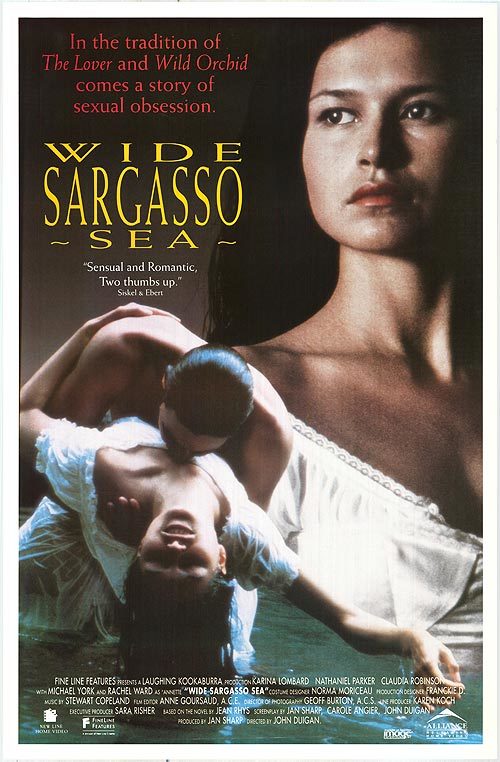
NOTE: For those interested, here is a link to the entire film of the 1993 Wide Sargasso Sea, the only feature film version of the novel. It's not bad, but it's not great...good actors, but it doesn't quite capture the magic and cruelty of the book. Still, if you dig the book, it's definitely worth a watch: https://www.youtube.com/watch?v=_vQuSVJPDWk
After you've read the very brief Part Three of Wide Sargasso Sea, answer the following as a Comment below (or e-mail it to me):
Part Three is the only part where Rhys explicitly ties her novel into Charlotte Bronte's Jane Eyre. Why do you think she does this? Earlier, she makes the connections tempting and likely, but never exact. Here she makes it clear that Antoinette is the "madwoman in the attic" from Bronte's novel. Do you think this part of the novel is even necessary? What does it add--or take away--from the other two parts? Does it seem like an afterthought? Or does it form a sharper critique of the earlier novel?
Part of me thinks that this part is necessary, but the other part of me doesn't. I feel like if she had left it were it ended in part 2, then there would have been no closure. But then again, this last part was significantly shorter than the others and seemed to be a bit rushed. Plus, the final part was really pretty direct about the connections to Charlotte Bronte's novel, and the fact that the previous two parts weren't makes this feel disjointed in a way. I wish that the third part had been similar to the former ones in its level of directness and that she had made it longer so that we as readers could see Antoinette's full descent into madness. However, if I really dig deep, the fact that it was so abrupt may be a sharper critique of the earlier novel. It may be her way of saying the following. "This is the only characterization she was given, but that's not all that she is. Her characterization was too brief and unfair. You portrayed her with only a few pages while you gave everyone else a whole book."
ReplyDeleteI completely agree...I find Part Three interesting, in that it throws us ahead to the novel, and seems to be a teasing attempt at saying "you see, it IS Jane Eyre I was writing about." But in a way, I don't think it works or is necessary...I wish it ended with Part Two, since what we have here seems like an afterthought, and not really the Antoinette we know. Maybe that's her point--that Jane Eyre's madwoman isn't Antoinette, and the fact that they don't match up only shows that Bronte couldn't really imagine her colonial counterpart?
DeleteIf the reader were aware of Charlotte Bronte’s Jane Eyre, there would be no reason for the reinforcing connection in part three. Rhys connects the two novels through part three because not all readers, like myself, would have been aware that Wide Sargasso Sea was a prequel to Jane Eyre. Rhys could have added more details about Antoinette’s time in captivity, but I think she wanted to keep it short because she did not want to alter the original Jane Eyre plot. Rhys knew exactly what she was doing while writing the final section of the book. It adds a conclusion that leads into Jane Eyre, and without this connection, there would be no confirmation of the two texts combining.
ReplyDeleteI believe part three is necessary. It makes the connection between the two novels and fulfills the warning given by Christophine concerning Antoinette's marriage. This passage articulated Antoinette's isolation so clearly, that by the time she sets the house on fire, it felt like Antoinette was completely physically alone and her decision to burn the house was not insanity, but sound reasoning.
ReplyDeleteI think part three almost serves as a plot twist. If one was reading this novel with no knowledge that it was a, quote-unquote, prequel to Jane Eyre, it feels like a mystery. The reader is trying to connect all of the dots, and then the answer is revealed. In addition, the third part clarifies the connection for readers who might not be familiar with Jane Eyre.
ReplyDeletePerhaps after nine long years of work on the novel, Rhys was unwilling to give up the original intention of the work, even if she was aware that the brilliant writing she had produced could stand independently from Jane Eyre. Even if it's unnecessary, and there is definitely an argument for that, it must have still been important to her in some way. I respect the desire to give recognition to one's inspirations, so it's fine by me that she included it.
ReplyDeleteI believe that part three was mandatory to put in this novel. If the author just simply took it out than it would leave out the major part that makes these two novels connect. If needed to they could take it out and It would make the novels stand alone, had the author wanted that. I had not read Jane Eyre so i was not familiar with Jane Eyre and this helped clarify for me.
ReplyDelete